Fast Worldwide Shipping With Tracked 48 hour DHL Express Delivery
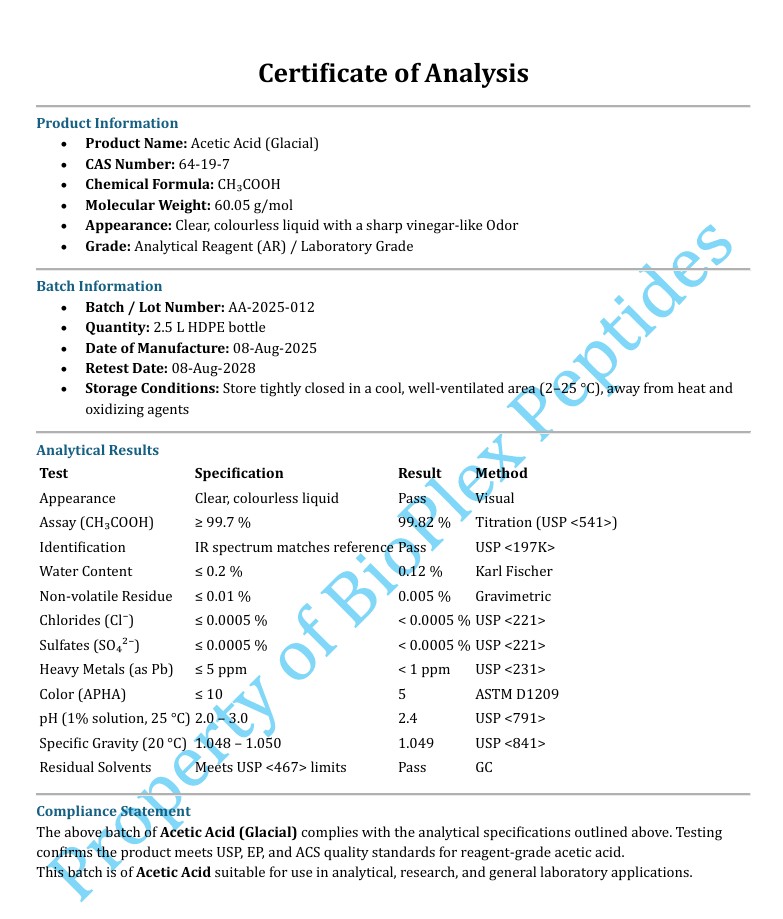
Acetic acid (CH₃COOH) is a weak, monoprotic carboxylic acid with a pKa of 4.76 at 25 °C, fully miscible in water and widely used to modulate pH during peptide reconstitution. Its predictable dissociation behaviour and compatibility with aqueous systems support solubility of acidic and neutral peptides. With a molar mass of 60.05 g/mol, it provides a controlled, mildly acidic environment ideal for preparing premium grade peptide solutions.
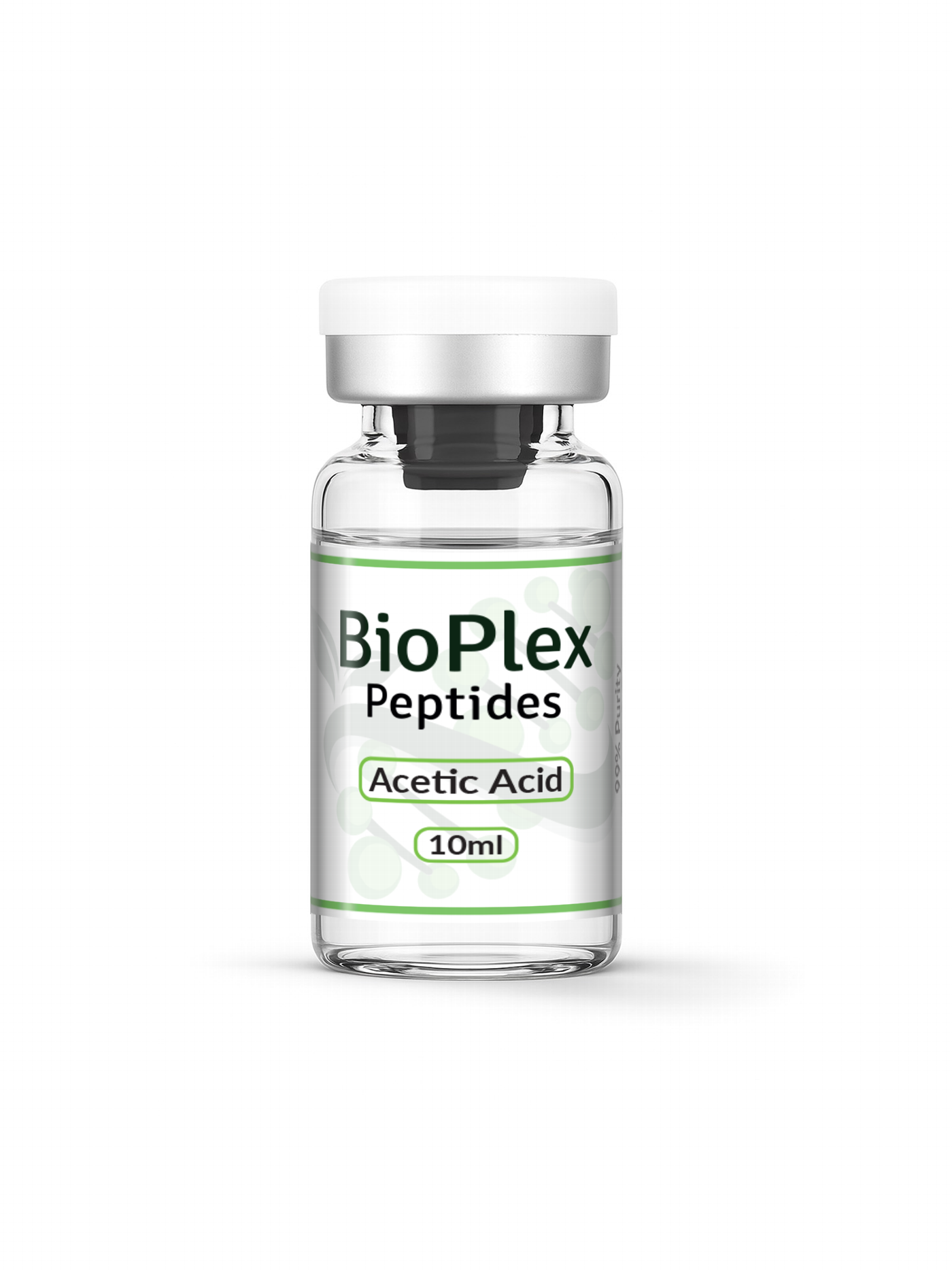
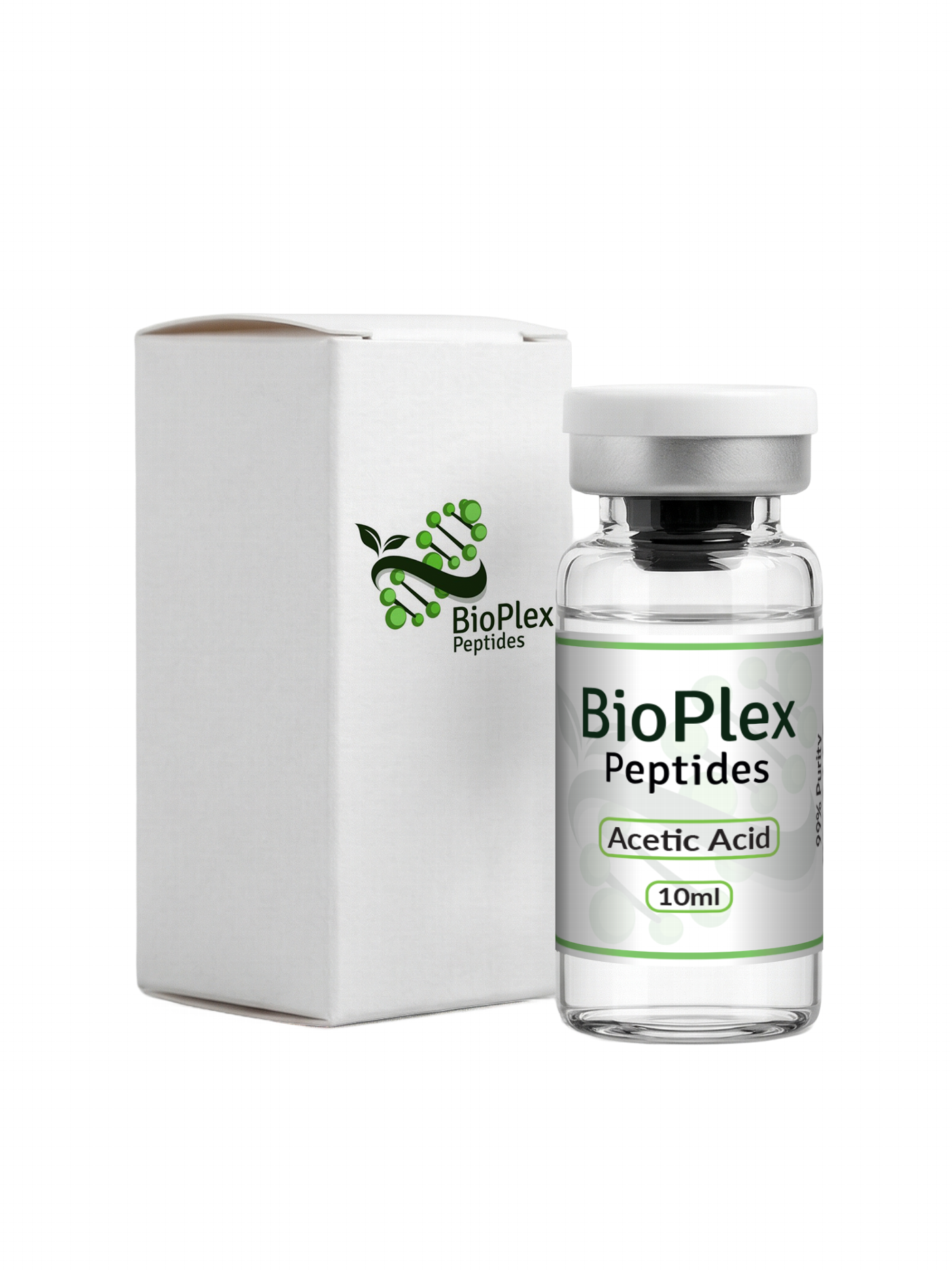
BioPlex Peptides Acetic Acid 10 ml is a high purity laboratory reagent supplied exclusively for in-vitro research use. Acetic acid is widely utilised in peptide research environments as a controlled acidic solvent to assist with peptide dissolution, pH adjustment, and the preparation of acetate-based peptide solutions. Its mild acidic profile supports improved solubility for peptides with limited aqueous stability, helping to reduce aggregation and enhance solution clarity during laboratory preparation. Acetic acid is particularly relevant in research workflows involving sensitive or low solubility peptide sequences, where precise pH control and reproducible preparation conditions are essential for consistent outcomes.
(Dilute with Bacteriostatic Water)
In laboratory workflows, acetic acid is frequently selected to support the reconstitution of peptides that demonstrate reduced solubility in neutral aqueous solutions. It is especially relevant for acetate salt peptides and peptide sequences that benefit from a mildly acidic environment during initial dissolution and preparation. From a biochemical standpoint, controlled pH adjustment using acetic acid can improve peptide ionisation, reduce intermolecular aggregation, and enhance solution clarity, supporting more consistent handling and analytical accuracy. Acetic acid is widely referenced in peptide research protocols involving low solubility, hydrophobic, or structurally sensitive peptides, where precise solvent conditions are critical. Its compatibility with downstream analytical techniques, including chromatography and mass spectrometry preparation, further supports its use in controlled in peptide research.
In peptide research workflows, a 50/50 mixture of acetic acid and Bacteriostatic water is commonly referenced during initial peptide reconstitution for sequences that exhibit reduced solubility in neutral aqueous environments. From a biochemical perspective, the inclusion of acetic acid provides controlled acidification, promoting peptide ionisation and reducing intermolecular aggregation that can occur when peptides are introduced directly into neutral pH solutions. This acidic environment supports improved dissolution kinetics, particularly for acetate salt peptides, hydrophobic sequences, or structurally complex peptides prone to clumping.
Some research peptides may appear slightly cloudy after reconstitution due to natural variations in peptide structure and batch‑specific pH levels. When this occurs, researchers can improve clarity and consistency by introducing a 1:1 ratio of Acetic Acid to Bacteriostatic water solution This helps the peptide fully unsuspend and supports the solution in reaching a more stable pH environment, which can differ subtly between manufacturing lots.
Using acetic acid during reconstitution is a widely recognised laboratory technique for enhancing peptide solubility, improving handling, and ensuring the material is ready for accurate experimental use. This step is particularly beneficial for hydrophobic peptides, complex amino‑acid chains, and peptides prone to partial precipitation after mixing.
Acetic acid is a chemically stable organic acid; however, once a container has been opened, appropriate storage and handling practices remain important to preserve purity and consistency for laboratory research use. In controlled in-vitro research environments, opened acetic acid solutions are generally considered suitable for continued use for up to 4-6 weeks, provided the container is tightly sealed and stored under stable conditions. This guidance reflects standard laboratory handling practices for low volatility organic acids. After opening, Acetic Acid should be stored at controlled room temperature, typically between 10 °C and 20 °C, in its original container with the cap securely closed to minimise evaporation and environmental contamination. Refrigeration is not required and freezing is not recommended, as temperature extremes may lead to condensation within the container or compromise container integrity. Consistent storage conditions help maintain concentration accuracy during peptide reconstitution workflows. Prior to use, the solution should be visually inspected. Acetic Acid should remain clear and colourless; any visible particulates, discolouration, or unexpected odour changes may indicate contamination or degradation and the solution should be discarded. When dispensing Acetic Acid, standard laboratory safety and aseptic handling practices should be followed to prevent cross contamination and maintain reagent quality.
(Read More About Reconstituation Solutions In Our Article)
Bacteriostatic Water 10ml
DMSO 10mg
Sterile Water 10ml
Trade supply
Peptides sets
Bulk purchase range
Acetic acid (CH₃COOH) is a weak, monoprotic carboxylic acid with a pKa of 4.76 at 25 °C, fully miscible in water and widely used to modulate pH during peptide reconstitution. Its predictable dissociation behaviour and compatibility with aqueous systems support solubility of acidic and neutral peptides. With a molar mass of 60.05 g/mol, it provides a controlled, mildly acidic environment ideal for preparing premium grade peptide solutions.
BioPlex Peptides Acetic Acid 10 ml is a high purity laboratory reagent supplied exclusively for in-vitro research use. Acetic acid is widely utilised in peptide research environments as a controlled acidic solvent to assist with peptide dissolution, pH adjustment, and the preparation of acetate-based peptide solutions. Its mild acidic profile supports improved solubility for peptides with limited aqueous stability, helping to reduce aggregation and enhance solution clarity during laboratory preparation. Acetic acid is particularly relevant in research workflows involving sensitive or low solubility peptide sequences, where precise pH control and reproducible preparation conditions are essential for consistent outcomes.
(Dilute with Bacteriostatic Water)
In laboratory workflows, acetic acid is frequently selected to support the reconstitution of peptides that demonstrate reduced solubility in neutral aqueous solutions. It is especially relevant for acetate salt peptides and peptide sequences that benefit from a mildly acidic environment during initial dissolution and preparation. From a biochemical standpoint, controlled pH adjustment using acetic acid can improve peptide ionisation, reduce intermolecular aggregation, and enhance solution clarity, supporting more consistent handling and analytical accuracy. Acetic acid is widely referenced in peptide research protocols involving low solubility, hydrophobic, or structurally sensitive peptides, where precise solvent conditions are critical. Its compatibility with downstream analytical techniques, including chromatography and mass spectrometry preparation, further supports its use in controlled in peptide research.
In peptide research workflows, a 50/50 mixture of acetic acid and Bacteriostatic water is commonly referenced during initial peptide reconstitution for sequences that exhibit reduced solubility in neutral aqueous environments. From a biochemical perspective, the inclusion of acetic acid provides controlled acidification, promoting peptide ionisation and reducing intermolecular aggregation that can occur when peptides are introduced directly into neutral pH solutions. This acidic environment supports improved dissolution kinetics, particularly for acetate salt peptides, hydrophobic sequences, or structurally complex peptides prone to clumping.
Some research peptides may appear slightly cloudy after reconstitution due to natural variations in peptide structure and batch‑specific pH levels. When this occurs, researchers can improve clarity and consistency by introducing a 1:1 ratio of Acetic Acid to Bacteriostatic water solution This helps the peptide fully unsuspend and supports the solution in reaching a more stable pH environment, which can differ subtly between manufacturing lots.
Using acetic acid during reconstitution is a widely recognised laboratory technique for enhancing peptide solubility, improving handling, and ensuring the material is ready for accurate experimental use. This step is particularly beneficial for hydrophobic peptides, complex amino‑acid chains, and peptides prone to partial precipitation after mixing.
Acetic acid is a chemically stable organic acid; however, once a container has been opened, appropriate storage and handling practices remain important to preserve purity and consistency for laboratory research use. In controlled in-vitro research environments, opened acetic acid solutions are generally considered suitable for continued use for up to 4-6 weeks, provided the container is tightly sealed and stored under stable conditions. This guidance reflects standard laboratory handling practices for low volatility organic acids. After opening, Acetic Acid should be stored at controlled room temperature, typically between 10 °C and 20 °C, in its original container with the cap securely closed to minimise evaporation and environmental contamination. Refrigeration is not required and freezing is not recommended, as temperature extremes may lead to condensation within the container or compromise container integrity. Consistent storage conditions help maintain concentration accuracy during peptide reconstitution workflows. Prior to use, the solution should be visually inspected. Acetic Acid should remain clear and colourless; any visible particulates, discolouration, or unexpected odour changes may indicate contamination or degradation and the solution should be discarded. When dispensing Acetic Acid, standard laboratory safety and aseptic handling practices should be followed to prevent cross contamination and maintain reagent quality.
(Read More About Reconstituation Solutions In Our Article)
Bacteriostatic Water 10ml
DMSO 10mg
Sterile Water 10ml
Trade supply
Peptides sets
Bulk purchase range


Allow the vial to reach room temperature
This helps prevent condensation, which can compromise sterility when you open the vial.

Draw up the solvent
Using a sterile syringe, measure the precise amount of bacteriostatic water or your chosen solvent.

Inject the solvent gently
Insert the needle into the vial at a 45-degree angle so the liquid runs down the inside wall, which reduces bubbling and foam.

Dissolve the peptide
Swirl the vial gently until the peptide powder is completely dissolved. Avoid shaking, as this can damage the peptide bonds.

Aliquot the solution
If smaller, single-use portions are needed, divide the solution into sterile microtubes using a new, sterile syringe or pipette for each.

If you have any questions regarding our research peptides for sale, please feel free to reach out below.